Guide
Chasen Bamboo Whisk Guide: Tine Count, Bamboo Colour, and Care
The short answer
A chasen (茶筅) is a single piece of bamboo, hand-split into dozens of fine tines, and it is still the tool that makes matcha foam properly rather than just dissolve. Two things you'll see on the label — tine count and bamboo colour — get treated as spec sheets by some sellers. They're not, quite. Tine count is a real, functional variable, but it's a hand-split, hand-counted approximation, not a lab measurement. Bamboo colour is almost entirely a tradition and tea-school marker. What actually matters day to day is simpler: rinse it right, dry it right, and retire it when the tines start going.
Tine count: a rough guide to foam, not a spec sheet
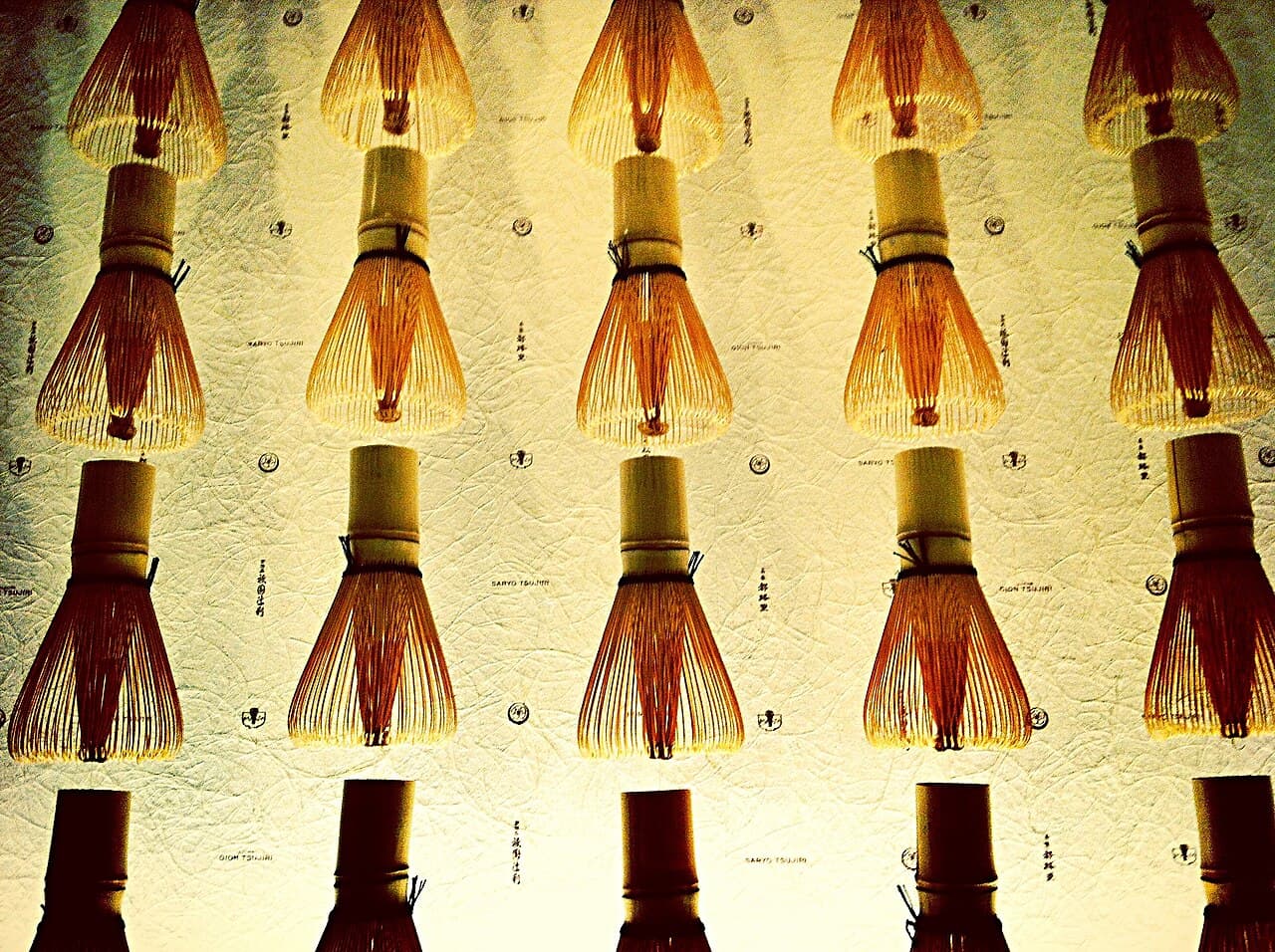
Chasen are traditionally hand-split from a single culm of bamboo, and by the time a maker is done, the tine count on a finished whisk typically falls somewhere in the range of roughly 60 to 120 — the city of Ikoma, where most of Japan's chasen are made, describes the process as splitting "60~120本という穂先" (60 to 120 tines) one at a time with a small blade (Ikoma City).
As a rule of thumb, the count tracks what the whisk is for. Fewer, thicker tines (toward the 60–80 end) are traditionally associated with koicha (濃茶, thick tea), which is kneaded into a smooth paste rather than whisked into foam — the whisk needs body and control more than surface area. More, finer tines (toward the 100–120 end) are associated with usucha (薄茶, thin tea), where the whisk has to work air into the liquid quickly to build a fine, short-lived foam; more tine surface area does that more easily (Mizuba Tea Co.; Wide Bamboo). An 80- or 100-tine whisk is the common, do-everything choice sold to people just starting to whisk usucha at home.
Treat the printed number loosely. Because each whisk is split by hand rather than machined, the actual count on a given piece can run a little above or below the label, and — as one chasen-focused retailer puts it — tine count "has never been the standard for determining quality" in traditional tea practice; it's a reference point, not a certificate (Nara Tea Co.). For the full whisking motion and how it fits into making a bowl of usucha at home, see how to make matcha.
Why the shape varies by school
Splitting doesn't happen in one pass. A maker first divides the bamboo into a limited number of primary sections — as few as 12, as many as 24 depending on the culm's thickness — then progressively subdivides those into the final fine tines (Japan Traditional Crafts Aoyama Square). The tips are also finished differently by tea school: straight for Mushanokōji-senke, curved for Urasenke, among other conventions. That's part of why two whisks both labelled "100-tine" can look and feel a little different in hand — school convention, not just count, shapes the final whisk.
Bamboo colour: tradition, not performance
Chasen are made from a few recognised bamboo colours. Pale, sun-dried white bamboo (白竹) is the most common and easiest to work; black or purple-toned bamboo (黒竹) darkens naturally with age; and sooted bamboo (煤竹) — dark, matte, and increasingly rare — is reclaimed from the smoke-blackened rafters of century-old farmhouses rather than grown that colour (Japan Traditional Crafts Aoyama Square).
These colours are generally tied to tea-school convention rather than to how the whisk performs: one retailer's guide associates sooted bamboo with Omotesenke, pale bamboo with Urasenke, and purple/black bamboo with Mushanokōji-senke, describing the choice as a matter of school affiliation and ceremonial appropriateness rather than a difference in foam or feel (e-cha.co.jp / CHANOYU). If you're buying for home use rather than for a specific school's keiko, colour is a reasonable thing to choose on looks alone.
Where they come from
Most Japanese chasen — including nearly every whisk sold as "Takayama chasen" — are still made in the Takayama district of Ikoma City, Nara Prefecture, a craft with roughly 500 years of continuous production dating to the mid-Muromachi period, and the whisk is formally recognised as a national traditional craft (伝統的工芸品) under Japan's Traditional Craft Industries Promotion Law (Nara Prefecture; Ikoma City).
Caring for a chasen
The care routine is short on purpose — bamboo doesn't need much, and over-handling is what shortens a whisk's life.
- Before first use, soak the tines briefly in water to soften them and release any curl from packaging.
- After every use, rinse in warm water only — no soap, no detergent, no dishwasher, and no scrubbing with a sponge or brush (e-cha.co.jp; Chiran Ichibanyama Tea Farm).
- Dry it tines-up, seated in a whisk stand (くせ直し, kusenaoshi) so the tines hold their splayed shape instead of bending closed; set it somewhere shaded and well-ventilated rather than in direct sun or sealed in a container, since bamboo left damp can mould.
- Check the tines before each use for splits or breakage.
When to replace it
Some outward splay and minor unevenness in the tines is normal wear from regular whisking and isn't, on its own, a reason to retire a chasen. The clear signal to replace one is physical damage: tines that have snapped off or gone visibly blunt at the tip no longer whisk cleanly and should be swapped out (Mizuba Tea Co.).
If you don't have one yet
A chasen is still the tool with the clearest result for straight usucha, but it isn't the only way to get matcha into your cup. If you're deciding whether it's worth buying one before your next order arrives, making matcha without a chasen walks through what a milk frother, a small kitchen whisk, or a shaker jar can and can't do instead.
FAQ
How many tines should a chasen have? Most whisks fall somewhere between roughly 60 and 120 hand-split tines. Fewer, thicker tines (around 60–80) are traditionally paired with koicha, which is kneaded rather than whisked to foam; more, finer tines (100–120) are traditionally paired with usucha, which needs more aeration to foam. For general home use, 80 or 100 tines is a common, unfussy choice.
Does the bamboo colour affect how matcha tastes or froths? Not that the sourced guides describe. The colours (pale, purple-black, or soot-darkened) are tied mainly to tea-school tradition and appearance rather than to whisking performance.
Can I wash a chasen with soap or in the dishwasher? No — retailers and producers consistently recommend rinsing in warm water only, with no soap, detergent, or dishwasher, since these can dry out or damage the tines.
How do I know when to replace my chasen? Once tines have snapped off or gone visibly blunt at the tip. Some splay and unevenness from regular use is normal and isn't itself a reason to replace it.
Why do some chasen have curved tips and others straight? The tips are finished differently by tea school — straight for Mushanokōji-senke, curved for Urasenke, among other conventions — so two whisks both labelled "100-tine" can look and feel a little different in hand. School convention, not just count, shapes the final whisk.
Sources
- Takayama Chasen — Nara Prefecture official traditional-craft page
- Ikoma City — Traditional Industries (Takayama Chasen)
- Takayama Chasen — Japan Traditional Crafts Aoyama Square (kogeijapan.com)
- How to Choose a Chasen — e-cha.co.jp / CHANOYU
- A Guide to The Chasen — Mizuba Tea Co.
- 80, 100, or 120 Prongs? The Matcha Whisk (Chasen) Comparison Guide — Wide Bamboo
- Chasen Tine Count Explained: 60 vs 80 vs 100 — Nara Tea Co.
- 茶筅の手入れ方法とは? — Chiran Ichibanyama Tea Farm blog
FAQ
- How many tines should a chasen have?
- Most whisks fall somewhere between roughly 60 and 120 hand-split tines. Fewer, thicker tines (around 60–80) are traditionally paired with koicha, which is kneaded rather than whisked to foam; more, finer tines (100–120) are traditionally paired with usucha, which needs more aeration to foam. For general home use, 80 or 100 tines is a common, unfussy choice.
- Does the bamboo colour affect how matcha tastes or froths?
- Not that the sourced guides describe. The colours (pale, purple-black, or soot-darkened) are tied mainly to tea-school tradition and appearance rather than to whisking performance.
- Can I wash a chasen with soap or in the dishwasher?
- No — retailers and producers consistently recommend rinsing in warm water only, with no soap, detergent, or dishwasher, since these can dry out or damage the tines.
- How do I know when to replace my chasen?
- Once tines have snapped off or gone visibly blunt at the tip. Some splay and unevenness from regular use is normal and isn't itself a reason to replace it.
- Why do some chasen have curved tips and others straight?
- The tips are finished differently by tea school — straight for Mushanokōji-senke, curved for Urasenke, among other conventions — so two whisks both labelled "100-tine" can look and feel a little different in hand. School convention, not just count, shapes the final whisk.
This article is for information only, not health or medical advice — we describe tea, not what tea will do for your body. Prices, availability and harvest details change; always check the linked vendor or official page before buying. Outbound links to vendors are plain links: we hold no affiliate accounts and earn nothing if you use them (see /how-we-review).